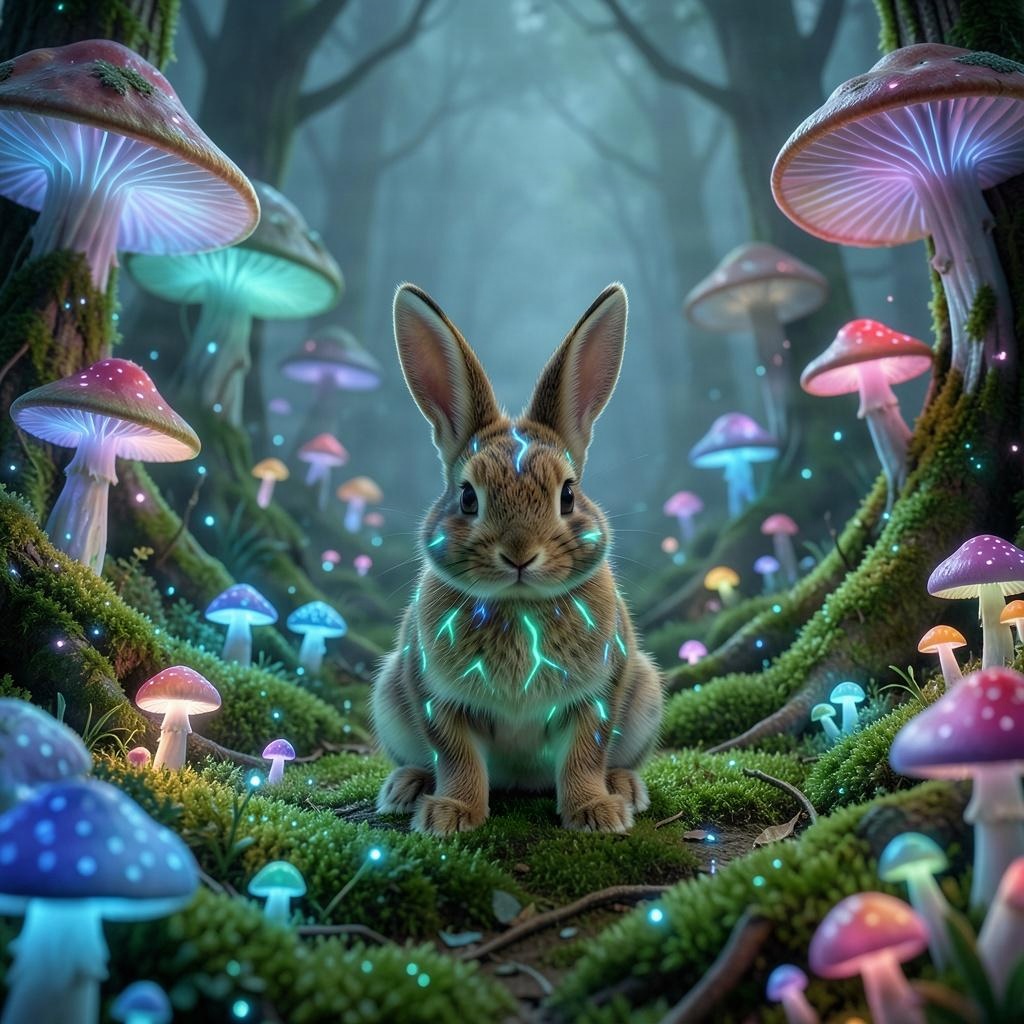
Lumivara
Leafy Hoppers
Classification
- Kind of creature
- Nocturnal Forest Foraging Species
- Habitat & range
- Tropical Forests, Jungle Undergrowth, and Coastal Woodlands
- Size & weight
- 25-35 cm, 2-4 pounds
- Lifespan
- 8 - 10 years
- How common
- Fairly Common
Appearance
- Body & features
- A small, round-bodied creature resembling a blend of a woodland hare, rodent, and forest hopper. Its fur is soft, dense, and warm brown mottled with darker patches. Its ears are long, rounded, and highly mobile. Its eyes are large, bright, and adapted for nighttime. Its body is compact with powerful hind legs. Rare individuals have Neon-responsive fur that glows and ripples with color. The colors include neon yellow, brilliant green, turquoise, blue-green, and neon orange.
- Colouring & glow
- Usually brown; sometimes glowing Neon colors
- How it moves
- Hops; Quick moving when necessary
- Sounds & calls
- Soft chirps and short calls; ear movements; body posture; scent markings.
- Senses
- Exceptional hearing; Sight excellent at night; highly sensitive to vibrations;
Behaviour
- Diet
- Omnivorous Nocturnal Foragers; Their diet consists primarily of: Fallen fruit; Seeds; Tender vegetation; Fungi; Small insects; Beetles; Larvae; Other small invertebrates.
- Temperament
- Gentle, curious, observant, non-aggressive
- Social life
- Solitary Foragers; Maintain loose social territories.
- Breeding & young
- Parents remain with their young during early development, teaching them safe foraging areas and routes through the forest.
- Abilities & adaptations
- The Lumivara's powerful hind legs, exceptional hearing, and large night-adapted eyes make them perfectly suited for navigating dense forests after dark. Rare individuals possess the extraordinary ability to detect and mimic nearby Neon wavelengths, their fur rippling with glowing colors and patterns that remain one of the forest's greatest mysteries.
- Weaknesses
- Curiosity
And people
- Danger to people
- Very Low
- How people use or tend it
- Childhood stories; Consider them a harmless, welcome presence around their homes.
- What people say about it
- "The children call them Little Lights. They leave offerings of fruit near the roots, hoping one will glow for them." "If you see one glowing, it means the forest is watching you."
- First appears in
- The Tropical Islands
Field notes
Species Name: Lumivara Common Name: Leafy Hoppers Classification: Nocturnal Forest Foraging Species Native Habitat: Tropical Forests, Jungle Undergrowth, and Coastal Woodlands Intelligence Level: Moderate to High Temperament: Gentle, curious, observant, non-aggressive
Physical Description: The Lumivara are small, round-bodied creatures resembling a blend of a woodland hare, rodent, and forest hopper.
Despite their compact size, they possess powerful hind legs, excellent hearing, and remarkable agility, allowing them to move quickly through dense vegetation.
An adult Lumivara typically measures approximately 25 to 35 centimeters (10 to 14 inches) in length and weighs between 1 and 2 kilograms (2 to 4 pounds).
Their bodies are covered in soft, dense fur that is normally warm brown mottled with darker patches. This coloration provides excellent camouflage among fallen leaves, tree roots, soil, and shadows.
Their most distinctive physical features are their long rounded ears, large bright eyes, compact bodies, and powerful hind legs.
The ears are highly mobile and can rotate independently, allowing the Lumivara to detect faint sounds from several directions while remaining almost completely still.
Their large eyes are especially well adapted to nighttime activity, allowing them to navigate beneath dense jungle vegetation after sunset.
Although most Lumivara are not naturally luminous, rare individuals can display a remarkable response to Neon wavelengths, causing their normally brown fur to glow and change color.
Distinguishing Features: Neon-Responsive Fur
Rare Lumivara possess an unusual ability to respond visibly to nearby Neon wavelengths. When exposed to Neon energy, their normally brown fur can begin producing a visible glow.
The coloration may shift through several colors, including: Neon yellow; Brilliant green; Turquoise; Blue-green; Neon orange.
The color does not simply change across the entire body at once. Instead, it can ripple across the fur in waves of light, creating the appearance of moving color beneath the creature's coat.
The response appears to be influenced by nearby Neon signatures. In one observed encounter, a Lumivara changed from yellow to green, then turquoise, and eventually shifted into the exact blue-green associated with Mara's Neon signature. When Lena approached, the creature changed again, producing the warm Neon orange associated with her signature.
The exact biological mechanism responsible for this phenomenon remains unknown.
Natural Abilities: Neon Color Response
A rare Neon-responsive Lumivara can detect and reproduce nearby Neon wavelengths.
This ability appears to allow the creature to: Detect nearby Neon signatures; Change its body coloration; Match specific Neon wavelengths; Shift between multiple colors; Respond to different Neon-producing individuals.
The creature's coloration may change rapidly or gradually depending on the surrounding Neon activity.
Pattern Formation: Some Neon-responsive Lumivara can produce organized patterns across their bodies.
Rather than simply changing color, sections of their fur can form: Bands; Repeating sequences; Color blocks; Wave patterns; Complex geometric arrangements.
The significance of these patterns is currently unknown.
During one documented observation, a Lumivara produced a pattern of blue-green and orange Neon bands that appeared identical to a pattern previously recorded around Aquala.
Whether this represents communication, environmental response, biological recognition, or another natural process remains undetermined.
Exceptional Hearing: Lumivara possess highly sensitive hearing.
Their large, mobile ears allow them to detect: Approaching predators; Movement through vegetation; Insects beneath fallen leaves; Distant animal calls; Changes in surrounding activity.
They frequently remain motionless while listening before deciding whether to continue moving.
This ability is particularly important because Lumivara are primarily nocturnal.
Social Structure: Lumivara are generally solitary foragers but maintain loose social territories.
They commonly encounter one another while feeding or traveling between shelter locations.
Individuals communicate through: Soft chirps; Short calls; Ear movements; Body posture; Scent markings; Neon coloration in rare responsive individuals.
Parents remain with their young during early development, teaching them safe foraging areas and routes through the forest.
Adult Lumivara generally prefer to maintain some distance from one another, although several may occupy the same general area when food is plentiful.
Habitat: The Lumivara inhabit many of the forested regions of the Worlds of Neon.
They are particularly common in: Tropical jungle; Coastal forests; Dense fern beds; Areas surrounding large trees; Forest floors; Riverbanks; Areas containing abundant fallen fruit.
They prefer locations offering dense vegetation and numerous hiding places.
They establish sleeping and sheltering hollows beneath tree roots, fallen logs, dense ferns, rocky formations, and natural cavities near the forest floor.
Diet: Lumivara are omnivorous nocturnal foragers.
Their diet consists primarily of: Fallen fruit; Seeds; Tender vegetation; Fungi; Small insects; Beetles; Larvae; Other small invertebrates.
They generally feed on food already present on the forest floor rather than actively hunting larger prey. Their habit of consuming fallen fruit and small insects makes them an important part of the forest ecosystem.
Behavior: A Lumivara rarely initiates conflict.
When encountering something unfamiliar, their typical sequence is: Stop; Listen; Observe; Determine whether the object presents a threat; Approach cautiously if curiosity outweighs caution; Retreat if danger is detected.
They are naturally cautious but also highly curious. Lumivara living near villages may become surprisingly comfortable around people, particularly when humans remain quiet and avoid sudden movements.
Neon-responsive individuals appear to display an unusual interest in Neon-producing organisms and equipment.
Rather than automatically retreating from unfamiliar scientific instruments, they may approach them to investigate.
**
Role in the Forest: Within the forests of Neon, Lumivara function as important nighttime foragers. Their feeding habits help distribute seeds and return nutrients to the forest ecosystem.
By consuming fallen fruit, fungi, insects, and other small organisms, they contribute to the balance of the forest floor. Because they are active primarily at night, they occupy an ecological niche different from many daytime forest species.
Their unusual sensitivity to Neon wavelengths may also make rare Lumivara valuable to researchers studying how living organisms respond to changes in Neon throughout the island.
For this reason, scientists are particularly interested in observing Neon-responsive individuals without disturbing their natural behavior.
Lifespan: Juvenile: 0 to 1 year Young Adult: 1 to 3 years Mature Adult: 4 to 8 years Elder: 9 to 12 years
Average lifespan is approximately 8 to 10 years.
Threat Assessment: Danger Level: Very Low
The Lumivara are not predators of large creatures and generally display little aggression.
If threatened they will: Freeze; Hide; Remain silent; Retreat; Leap rapidly through vegetation.
Direct confrontation is extremely rare.
Their primary defenses are camouflage, exceptional hearing, agility, and their ability to disappear quickly into dense vegetation.
Known Nicknames: Leafy Hoppers; Glow Hoppers; Neon Hoppers; Forest Hoppers; Little Lights; Color Hoppers; Night Hoppers; Living Lanterns.
Among the villagers, the nickname Leafy Hoppers is the most common because of their long ears, powerful jumping ability, and habit of moving through dense leafy vegetation.